AI Assistant Chatgpt

AI Assistant Chatgpt — independent reviews, comparisons, pricing and step-by-step guides on Aizhi.

  • The Business Cloud

    The Business Cloud

    The Business Cloud is an API enabled self-service platform, developed by Domo, that provides an array of services like data connection and data visualization. == History == Domo, Inc. was founded in 2010 by Josh James who also co-founded the web analytics software company Omniture in 1996, which he took public in 2006. Domo launched the Domo Appstore, with 1,000 apps with social and mobile capabilities, in 2016. This appstore creates a network of business apps and an ecosystem of companies into a single, integrated business cloud. This decision came after Domo announced a $131 million round of funding from BlackRock. According to the company, the concept behind The Business Cloud is to connect smaller clouds relating to apps or other functional areas of a business into a single business cloud that allows self-service and other social features to customers. == Services == The Business Cloud is offered as a free service, claimed to be the world's first business cloud with Domo appstore as one of its core services. This free package includes all of the Domo's features and functionality including Domo platform, Domo Apps, visualizations, alerts, company directories, org charts, profiles, tasks and Domo Mobile. The Business Cloud allows customers to leverage their preferred cloud as well as on-premises software and monitor all aspects of their business in routine. The company is supported by a $500 million fund from investors all over the world.

    Read more →
  • GOLOG

    GOLOG

    GOLOG is a high-level logic programming language for the specification and execution of complex actions in dynamical domains. It is based on the situation calculus. It is a first-order logical language for reasoning about action and change. GOLOG was developed at the University of Toronto. == History == The concept of situation calculus on which the GOLOG programming language is based was first proposed by John McCarthy in 1963. == Description == A GOLOG interpreter automatically maintains a direct characterization of the dynamic world being modeled, on the basis of user supplied axioms about preconditions, effects of actions and the initial state of the world. This allows the application to reason about the condition of the world and consider the impacts of different potential actions before focusing on a specific action. Golog is a logic programming language and is very different from conventional programming languages. A procedural programming language like C defines the execution of statements in advance. The programmer creates a subroutine which consists of statements, and the computer executes each statement in a linear order. In contrast, fifth-generation programming languages like Golog work with an abstract model with which the interpreter can generate the sequence of actions. The source code defines the problem and it is up to the solver to find the next action. This approach can facilitate the management of complex problems from the domain of robotics. A Golog program defines the state space in which the agent is allowed to operate. A path in the symbolic domain is found with state space search. To speed up the process, Golog programs are realized as hierarchical task networks. Apart from the original Golog language, there are some extensions available. The ConGolog language provides concurrency and interrupts. Other dialects like IndiGolog and Readylog were created for real time applications in which sensor readings are updated on the fly. == Uses == Golog has been used to model the behavior of autonomous agents. In addition to a logic-based action formalism for describing the environment and the effects of basic actions, they enable the construction of complex actions using typical programming language constructs. It is also used for applications in high level control of robots and industrial processes, virtual agents, discrete event simulation etc. It can be also used to develop Belief Desire Intention-style agent systems. == Planning and scripting == In contrast to the Planning Domain Definition Language, Golog supports planning and scripting as well. Planning means that a goal state in the world model is defined, and the solver brings a logical system into this state. Behavior scripting implements reactive procedures, which are running as a computer program. For example, suppose the idea is to authoring a story. The user defines what should be true at the end of the plot. A solver gets started and applies possible actions to the current situation until the goal state is reached. The specification of a goal state and the possible actions are realized in the logical world model. In contrast, a hardwired reactive behavior doesn't need a solver but the action sequence is provided in a scripting language. The Golog interpreter, which is written in Prolog, executes the script and this will bring the story into the goal state.

    Read more →
  • AI Mode

    AI Mode

    AI Mode is a search feature used within Google Search. In March 2025, Google introduced an experimental "AI Mode" within its search platform, enabling users to input complex, multi-part queries and receive comprehensive, AI-generated responses. This feature uses Google's Gemini model, which enhances the system's reasoning capabilities and supports multimodal inputs, including text, images, and voice. Users need to be signed in to be able to use the image generation features. Initially, AI Mode was available to Google One AI Premium subscribers in the United States, who could access it through the Search Labs platform. This phased rollout allowed Google to gather user feedback and refine the feature before a broader release.

    Read more →
  • .ai

    .ai

    .ai is the Internet country code top-level domain (ccTLD) for Anguilla, a British Overseas Territory in the Caribbean. It is administered by the government of Anguilla. It is a popular domain hack with companies and projects related to the artificial intelligence industry (AI). Google's ad targeting treats .ai as a generic top-level domain (gTLD) because "users and website owners frequently see [the domain] as being more generic than country-targeted." In 2021, Google Search analyst Gary Illyes announced that ".ai" had been added to Google’s list of generic country-code top-level domains, meaning that Google would no longer infer Anguilla-specific targeting from the ccTLD. Identity Digital began managing the domain as of January 2025. == Second and third level registrations == Registrations within off.ai, com.ai, net.ai, and org.ai are available worldwide without restriction. From 15 September 2009, second level registrations within .ai are available to everyone worldwide. == Registration == The minimum registration term allowed for .ai domains is 2 through 10 years for registration and renewal, and a 2-year renewal for domain transfer. Identity Digital is the authority in charge of managing this extension. Registrations began on 16 February 1995. The limits on the number of characters used for the domain name are, at a minimum, from 1 to 3, depending on the registrar, and always at most 63 characters. The character set supported for .ai domain names includes A–Z, a–z, 0–9, and hyphen. As of November 2022, .ai domains cannot accommodate IDN characters. There are no requirements for registering a domain, including local and foreign residents. A .ai domain can be suspended or revoked, if the domain is involved in illegal activity such as violating trademarks or copyrights. Usage must not violate the laws of Anguilla. Anguilla uses the UDRP. Filing a UDRP challenge requires using one of the ICANN Approved Dispute Resolution Service Providers. If the domain is with an ICANN accredited registrar, they should work with the arbitrator. Usually this means either doing nothing or transferring a domain. .ai domains are transferable to any desired registrars as the registration of domain is done maintaining EPP. There used to be a whois.ai-based platform of expired domains in which those could be procured and auctioned every ten days through a standard online process. The last auctions of such kind closed there in December 2024; the platform had been scheduled for shutdown on 30 June 2025, but remained online in the months following that date. == Valuation == Domains cost depends on the registrar, with yearly fees ranging from US$140 (the base fee, as established by Anguilla) to $200. As of July 2025, the highest-valued .ai domain is an undisclosed one sold on 8 November 2023, on Escrow.com, for US$1,500,000—months after an initial $300,000 sale to the same buyer. Among the publicly disclosed ones, the most valued, fin.ai, was sold for $1,000,000 in March 2025. On 16 December 2017, the .ai registry started supporting the Extensible Provisioning Protocol (EPP) and migrated all of its domains onto an EPP system. Consequently, many registrars are allowed to sell .ai domains. Since that date, the .ai ccTLD has also been popular with artificial intelligence companies and organisations. Though such trends are primarily seen among new AI based companies or startups, many established AI and Tech companies preferred not to opt for .ai domains. For example, DeepMind has its domain retained at .com; Meta has redirected its facebook.ai domain to ai.meta.com. == Impact on Anguilla's economy == The registration fees earned from the .ai domains go to the treasury of the Government of Anguilla. As per a 2018 New York Times report, the total revenue generated out of selling .ai domains was $2.9 million. In 2023, Anguilla's government made about US$32 million from fees collected for registering .ai domains; that amounted to over 10% of gross domestic product for the territory. "In the years before the real breakthrough of AI, revenue from .ai domains made up less than 1% of our state income, by 2025 it will be around 47%," explained Jose Vanterpool, Minister of Infrastructure and Communications (MICUHITES), in an interview with BBC. The high 90% renewal rate of .ai domains and the 2025 renewal wave of domains registered in 2023 are driving another surge in state revenues, according to Domaintechnik.

    Read more →
  • Tridium

    Tridium

    Tridium Inc. is an American engineering hardware and software company based in Richmond, Virginia, whose products facilitate and integrate the automation of building and other engineering control systems. Since November 2005, the company has operated as an independent business entity of Honeywell International Inc. == History == Tridium Inc. was founded in 1995. In 1999, Tridium launched the Niagara Framework, a software infrastructure that connects all systems and devices to a central console. In 2002, John Petze became president and CEO, replacing Jerry Frank. The company was acquired by Honeywell International Inc in 2005. == Products == Tridium's products facilitate by integrating building automation using open and proprietary communications protocols such as Modbus, Lonworks and BACnet. Tridium is the developer of Niagara Framework. The Niagara Framework is a universal software infrastructure that allows building controls integrators, HVAC and mechanical contractors to build custom, web-enabled applications for accessing, automating and controlling smart devices real-time via local network or over the Internet.

    Read more →
  • Artificial reproduction

    Artificial reproduction

    Artificial reproduction is the re-creation of life brought about by means other than natural ones. It is new life built by human plans and projects. Examples include artificial selection, artificial insemination, in vitro fertilization, artificial womb, artificial cloning, and kinematic replication. Artificial reproduction is one aspect of artificial life. Artificial reproduction can be categorized into one of two classes according to its capacity to be self-sufficient: non-assisted reproductive technology and assisted reproductive technology. Cutting plants' stems and placing them in compost is a form of assisted artificial reproduction, xenobots are an example of a more autonomous type of reproduction, while the artificial womb presented in the movie the Matrix illustrates a non assisted hypothetical technology. The idea of artificial reproduction has led to various technologies. == Theology == Humans have aspired to create life since immemorial times. Most theologies and religions have conceived this possibility as exclusive of deities. Christian religions consider the possibility of artificial reproduction, in most cases, as heretical and sinful. == Philosophy == Although ancient Greek philosophy raised the concept that man could imitate the creative capacity of nature, classic Greeks thought that if possible, human beings would reproduce things as nature does, and vice versa, nature would do the things that man does in the same way. Aristotle, for example, wrote that if nature made tables, it would make them just as men do. In other words, Aristotle said that if nature were to create a table, such table will look like a human-made table. Correspondingly, Descartes envisioned the human body, and nature, as a machine. Cartesian philosophy does not stop seeing a perfect mirror between nature and the artificial. However, Kant revolutionized this old idea by criticizing such naturalism. Kant pedagogically wrote: "Reason, in order to be taught by nature, must approach nature with its principles in one hand, according to which the agreement among appearances can count as laws, and, in the other hand, the experiment thought out in accord with these principles—in order to be instructed by nature not like a pupil, who has recited to him whatever the teacher wants to say, but like an appointed judge who compels witnesses to answer the questions he puts to them.". Humans are not instructed by nature but rather use nature as raw material to invent. Humans find alternatives to the natural restrictions imposed by natural laws thus, nature is not necessarily mirrored. In accordance with Kant (and contrary to what Aristotle thought) Karl Marx, Alfred Whitehead, Jaques Derrida and Juan David García Bacca noticed that nature is incapable of reproducing tables; or airplanes, or submarines, or computers. If nature tried to create airplanes, it would produce birds. If nature tried to create submarines, it would get fishes. If nature tried to create computers, brains would grow. And if nature tried to create man, modern man, monkeys will be evolved. According to Whitehead, if we look for something natural in artificial life, in the most elaborate cases, if anything, only atoms remain natural. Juan David Garcia Bacca summarized, “It will not come out from wood, it will not be born, a galley; from clay, a vessel; from linen, a dress; from iron, a lever,...From natural, artificial. In the artificial, the natural is reduced to a simple raw material, even though it is perfectly specified with natural specification. The artificial is the real, positive, and original negation of the natural: of species, of genus and of essence. Thus, its ontology is superior to natural ontology. And for this very reason Marx did not attach any importance to Darwin, whose evolutionism is confined to the natural order: to changes, at most, from variety to variety, from species to species... natural. For the same reason, nature has no dialectics, even though continuous evolution and selection can occur. The dialectic cannot emerge from the natural, for deeper reasons than, using today's terms, from a bird, an airplane cannot emerge; from fish, a submarine; from ears, a telephone; from eyes, a television; from a brain, a digital computer; from feet, a car; from hands, an engine; from Euclid, Descartes; from Aristotle, Newton; from Plato, Marx.” According to García Bacca, the major difference between natural causes and artificial causes is that nature does not have plans and projects, while humans design things following plans and projects. In contrast, other influential authors such as Michael Behe have depicted the concept and promoted the idea of intelligent design, a notion that has aroused several doubts and heated controversies, as it reframe natural causes in accordance with a natural plan. Previous ideas that have also provided a positive 'sense' to natural reproduction, are orthogenesis, syntropy, orgone and morphic resonance, among others. Although, these ideas have been historically marginalized and often called pseudoscience, recently Bio-semioticians are reconsidering some of them under symbolic approaches. Current metaphysics of science actually recognizes that the artificial ways of reproduction are diverse from nature, i.e., unnatural, anti-natural or supernatural. Because Biosemiotics does not focus on the function of life but on its meaning, it has a better understanding of the artificial than classic biology. == Science == Biology, being the study of cellular life, addresses reproduction in terms of growth and cellular division (i.e., binary fission, mitosis and meiosis); however, the science of artificial reproduction is not restricted by the mirroring of these natural processes.The science of artificial reproduction is actually transcending the natural forms, and natural rules, of reproduction. For example, xenobots have redefined the classical conception of reproduction. Although xenobots are made of eukariotic cells they do not reproduce by mitosis, but rather by kinematic replication. Such constructive replication does not involve growing but rather building. == Assisted reproductive technologies == Assisted reproductive technology (ART)'s purpose is to assist the development of a human embryo, commonly because of medical concerns due to fertility limitations. == Non-assisted reproductive technologies == Non-assisted reproductive technologies (NART) could have medical motivations but are mostly driven by a wider heterotopic ambition. Although, NARTs are initially designed by humans, they are programed to become independent of humans to a relative or absolute extent. James Lovelock proposed that such novelties could overcome humans. === Artificial cloning === Cloning is the cellular reproductive processes where two or more genetically identical organisms are created, either by natural or artificial means. Artificial cloning normally involves editing the genetic code, somatic cell nuclear transfer and 3D bioprinting. === Non-assisted artificial womb === A non-assisted artificial womb or artificial uterus is a device that allow for ectogenesis or extracorporeal pregnancy by growing an embryonic form outside the body of an organism (that would normally carry the embryo to term) without any human assistance. The aspect of non-assistance is the key distinction between the current artificial womb technology (AWT) in modern medical research, which still relies on human assistance. With this non-assisted hypothetical technology, a zygote or stem cells are used to create an embryo that is then incubated and monitored by artificial intelligence (AI) within a chamber composed of biocompatible material. The AI maintains the necessary conditions for the embryo to develop and thrive, proceeding to mimic organic labor and childbirth in order to best help the embryo adjust to the outside world. Ectogenesis—gestation, depicted in the science fiction movie The Matrix, is a fast approaching reality. This type of innovation presupposes that vertebrate wombs are not the only way for bearing humans or other similar forms of life. === Kinematic replication === Self-replication without binary fission, meiosis, mitosis (or any other form of cellular reproduction that involves division and growing) can be achieved. Xenobots are an example of kinematic replication. They are biobots, named after the African clawed frog (Xenopus laevis). Xenobots are cellular life forms designed by using artificial intelligence to build more of themselves by combining frog cells in a liquid medium. The term kinematic replication is usually reserved for biomolecules (e.g. DNA, RNA, prions, etc.) and artificially designed cellular forms (e.g. xenobots). === Machine constructive replication === Machine constructive replication mimics human traditional manufacturing but is entirely self-automated. Such constructive replication is a more general form of kinematic replication, which does not necessarily

    Read more →
  • Winner-take-all in action selection

    Winner-take-all in action selection

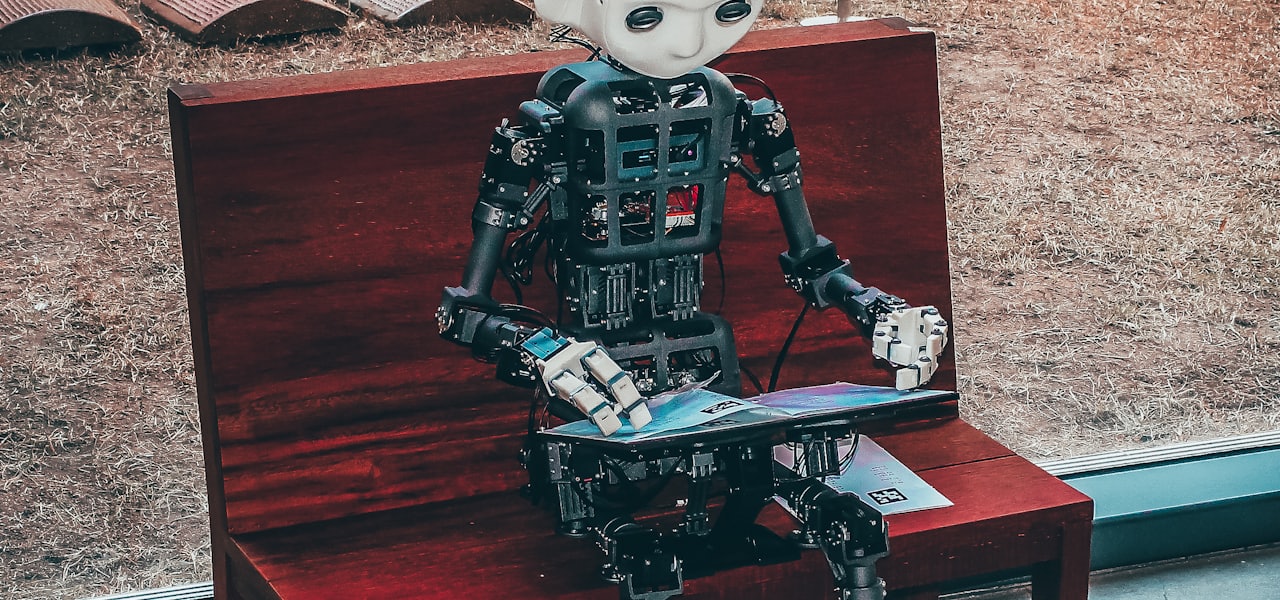
    Winner-take-all is a computer science concept that has been widely applied in behavior-based robotics as a method of action selection for intelligent agents. Winner-take-all systems work by connecting modules (task-designated areas) in such a way that when one action is performed it stops all other actions from being performed, so only one action is occurring at a time. The name comes from the idea that the "winner" action takes all of the motor system's power. == History == In the 1980s and 1990s, many roboticists and cognitive scientists were attempting to find speedier and more efficient alternatives to the traditional world modeling method of action selection. In 1982, Jerome A. Feldman and D.H. Ballard published the "Connectionist Models and Their Properties", referencing and explaining winner-take-all as a method of action selection. Feldman's architecture functioned on the simple rule that in a network of interconnected action modules, each module will set its own output to zero if it reads a higher input than its own in any other module. In 1986, Rodney Brooks introduced behavior-based artificial intelligence. Winner-take-all architectures for action selection soon became a common feature of behavior-based robots, because selection occurred at the level of the action modules (bottom-up) rather than at a separate cognitive level (top-down), producing a tight coupling of stimulus and reaction. == Types of winner-take-all architectures == === Hierarchy === In the hierarchical architecture, actions or behaviors are programmed in a high-to-low priority list, with inhibitory connections between all the action modules. The agent performs low-priority behaviors until a higher-priority behavior is stimulated, at which point the higher behavior inhibits all other behaviors and takes over the motor system completely. Prioritized behaviors are usually key to the immediate survival of the agent, while behaviors of lower priority are less time-sensitive. For example, "run away from predator" would be ranked above "sleep." While this architecture allows for clear programming of goals, many roboticists have moved away from the hierarchy because of its inflexibility. === Heterarchy and fully distributed === In the heterarchy and fully distributed architecture, each behavior has a set of pre-conditions to be met before it can be performed, and a set of post-conditions that will be true after the action has been performed. These pre- and post-conditions determine the order in which behaviors must be performed and are used to causally connect action modules. This enables each module to receive input from other modules as well as from the sensors, so modules can recruit each other. For example, if the agent's goal were to reduce thirst, the behavior "drink" would require the pre-condition of having water available, so the module would activate the module in charge of "find water". The activations organize the behaviors into a sequence, even though only one action is performed at a time. The distribution of larger behaviors across modules makes this system flexible and robust to noise. Some critics of this model hold that any existing set of division rules for the predecessor and conflictor connections between modules produce sub-par action selection. In addition, the feedback loop used in the model can in some circumstances lead to improper action selection. === Arbiter and centrally coordinated === In the arbiter and centrally coordinated architecture, the action modules are not connected to each other but to a central arbiter. When behaviors are triggered, they begin "voting" by sending signals to the arbiter, and the behavior with the highest number of votes is selected. In these systems, bias is created through the "voting weight", or how often a module is allowed to vote. Some arbiter systems take a different spin on this type of winner-take-all by using a "compromise" feature in the arbiter. Each module is able to vote for or against each smaller action in a set of actions, and the arbiter selects the action with the most votes, meaning that it benefits the most behavior modules. This can be seen as violating the general rule against creating representations of the world in behavior-based AI, established by Brooks. By performing command fusion, the system is creating a larger composite pool of knowledge than is obtained from the sensors alone, forming a composite inner representation of the environment. Defenders of these systems argue that forbidding world-modeling puts unnecessary constraints on behavior-based robotics, and that agents benefits from forming representations and can still remain reactive.

    Read more →
  • Machine-learned interatomic potential

    Machine-learned interatomic potential

    Machine-learned interatomic potentials (MLIPs), or simply machine learning potentials (MLPs), are interatomic potentials constructed using machine learning. Beginning in the 1990s, researchers have employed such programs to construct interatomic potentials by mapping atomic structures to their potential energies. These potentials are referred to as MLIPs or MLPs. Such machine learning potentials promised to fill the gap between density functional theory, a highly accurate but computationally intensive modelling method, and empirically derived or intuitively-approximated potentials, which were far lighter computationally but substantially less accurate. Improvements in artificial intelligence technology heightened the accuracy of MLPs while lowering their computational cost, increasing the role of machine learning in fitting potentials. Machine learning potentials began by using neural networks to tackle low-dimensional systems. While promising, these models could not systematically account for interatomic energy interactions; they could be applied to small molecules in a vacuum, or molecules interacting with frozen surfaces, but not much else – and even in these applications, the models often relied on force fields or potentials derived empirically or with simulations. These models thus remained confined to academia. Modern neural networks construct highly accurate and computationally light potentials, as theoretical understanding of materials science was increasingly built into their architectures and preprocessing. Almost all are local, accounting for all interactions between an atom and its neighbor up to some cutoff radius. There exist some nonlocal models, but these have been experimental for almost a decade. For most systems, reasonable cutoff radii enable highly accurate results. Almost all neural networks intake atomic coordinates and output potential energies. For some, these atomic coordinates are converted into atom-centered symmetry functions. From this data, a separate atomic neural network is trained for each element; each atomic network is evaluated whenever that element occurs in the given structure, and then the results are pooled together at the end. This process – in particular, the atom-centered symmetry functions which convey translational, rotational, and permutational invariances – has greatly improved machine learning potentials by significantly constraining the neural network search space. Other models use a similar process but emphasize bonds over atoms, using pair symmetry functions and training one network per atom pair. Other models to learn their own descriptors rather than using predetermined symmetry-dictating functions. These models, called message-passing neural networks (MPNNs), are graph neural networks. Treating molecules as three-dimensional graphs (where atoms are nodes and bonds are edges), the model takes feature vectors describing the atoms as input, and iteratively updates these vectors as information about neighboring atoms is processed through message functions and convolutions. These feature vectors are then used to predict the final potentials. The flexibility of this method often results in stronger, more generalizable models. In 2017, the first-ever MPNN model (a deep tensor neural network) was used to calculate the properties of small organic molecules. == Gaussian Approximation Potential (GAP) == One popular class of machine-learned interatomic potential is the Gaussian Approximation Potential (GAP), which combines compact descriptors of local atomic environments with Gaussian process regression to machine learn the potential energy surface of a given system. To date, the GAP framework has been used to successfully develop a number of MLIPs for various systems, including for elemental systems such as carbon, silicon, phosphorus, and tungsten, as well as for multicomponent systems such as Ge2Sb2Te5 and austenitic stainless steel, Fe7Cr2Ni. == Equivariant graph neural networks == A significant limitation of early MPNNs was that they were not inherently equivariant to rotations and reflections of atomic structures — meaning predictions could change depending on how a molecule was oriented in space. Beginning around 2021, a new class of models addressed this by incorporating equivariance directly into the message-passing layers using spherical harmonics and irreducible representations. Notable examples include NequIP (2021), MACE (2022), and GemNet-OC (2022). These equivariant architectures proved substantially more data-efficient and accurate than their predecessors, and became the dominant paradigm for high-accuracy MLIPs. == Universal MLIPs and large-scale datasets == Early MLIPs were system-specific, trained on a few thousand structures of a single material. A major shift occurred with the creation of large, chemically diverse datasets enabling models that generalize across many elements, bonding environments, and application domains — so-called universal MLIPs. A key driver was the Open Catalyst Project (OC20, OC22), a collaboration between Meta AI (FAIR) and Carnegie Mellon University launched in 2020. OC20 comprises approximately 1.3 million DFT relaxations across 82 elements, designed to accelerate the discovery of catalysts for renewable energy applications. It was among the first datasets large enough to train GNNs that generalize across diverse chemical systems, and established a widely-used benchmark for the field. A subsequent dataset, Open Direct Air Capture (OpenDAC 2023 and OpenDAC 2025), applied the same approach to carbon capture, providing a large computational database of metal-organic frameworks and sorbent candidates evaluated for CO₂ capture, generated using nearly 400 million CPU hours of quantum chemistry calculations in collaboration with Georgia Tech. These datasets revealed a new challenge: the GNN architectures most effective for atomic simulations were memory-intensive, as they model higher-order interactions between triplets or quadruplets of atoms, making it difficult to scale model size. Graph Parallelism, introduced by Sriram et al. (ICLR 2022), addressed this by distributing a single input graph across multiple GPUs — a distinct strategy from data parallelism (which distributes training examples) or model parallelism (which distributes layers). This enabled training GNNs with hundreds of millions to billions of parameters for the first time. Building on these foundations, Meta FAIR released the Universal Model for Atoms (UMA) in 2025, trained on approximately 500 million unique 3D atomic structures spanning molecules, materials, and catalysts — the largest training run to date for an MLIP. UMA introduced a Mixture of Linear Experts (MoLE) architecture, enabling one model to learn from datasets generated by different DFT codes and settings without significant inference overhead. It matches or surpasses specialized models across catalysis, materials, and molecular benchmarks without task-specific fine-tuning, and has been described as marking a "pre/post-UMA" divide in the field. == Applications == Catalyst discovery: MLIPs have significantly accelerated the computational screening of heterogeneous catalysts by replacing expensive DFT relaxations with fast neural network surrogates. The Open Catalyst Project explicitly targets this application, aiming to identify new catalysts for green hydrogen production and other renewable energy reactions. Carbon capture: The OpenDAC project applies universal MLIPs to screening sorbent materials for direct air capture of CO₂, a key technology for climate change mitigation. AI-accelerated screening allows evaluation of orders of magnitude more candidate materials than traditional DFT workflows. Drug discovery and molecular design: MLIPs are increasingly used in pharmaceutical research to model molecular conformations and binding energies. The Open Molecules 2025 (OMol25) dataset, released by Meta FAIR in 2025, provides high-accuracy calculations for a large set of molecular systems to support this use case. Materials discovery: Universal MLIPs enable high-throughput screening of novel inorganic materials, including battery electrolytes, semiconductors, and superconductors, by rapidly estimating stability and properties across large chemical spaces.

    Read more →
  • Radar geo-warping

    Radar geo-warping

    Radar geo-warping is the adjustment of geo-referenced radar images and video data to be consistent with a geographical projection. This image warping avoids any restrictions when displaying it together with video from multiple radar sources or with other geographical data including scanned maps and satellite images which may be provided in a particular projection. There are many areas where geo warping has unique benefits: Single radar video signal displayed together with maps of different geographical projections. E.g. Mercator UTM stereographic Multiple radar video signals displayed simultaneously: Having the computing power to do so on one computer. Adapting the projection of all radar signals allowing the geographically correct display and accurate superimposition of those videos. Slant range correction: a modern 3D radar system can measure the height of a target and hence it is possible to correct the radar video by the real corrected range of the target. Slant Range Correction also allows to compensate the radar tower height e.g. for maritime surveillance radars. == Introduction == Radar video presents the echoes of electromagnetic waves a radar system has emitted and received as reflections afterwards. These echoes are typically presented on a computer screen with a color-coding scheme depicting the reflection strength. Two problems have to be solved during such a visualization process. The first problem arises from the fact that typically the radar antenna turns around its position and measures the reflection echo distances from its position in one direction. This effectively means that the radar video data are present in polar coordinates. In older systems the polar oriented picture has been displayed in so called plan position indicators (PPI). The PPI-scope uses a radial sweep pivoting about the center of the presentation. This results in a map-like picture of the area covered by the radar beam. A long-persistence screen is used so that the display remains visible until the sweep passes again. Bearing to the target is indicated by the target's angular position in relation to an imaginary line extending vertically from the sweep origin to the top of the scope. The top of the scope is either true north (when the indicator is operated in the true bearing mode) or ship's heading (when the indicator is operated in the relative bearing mode). For visualization on a modern computer screen the polar coordinates have to be converted into Cartesian coordinates. This process called radar scan conversion is presented with more detail in the next section. The second problem to solve arises from the fact that a radar system is placed in the real world and measures real world echo positions. These echoes have to be displayed together with other real world data like object positions, vector maps and satellite images in a consistent way. All this information refers to the curved earth surface but is displayed on a flat computer display. Building a link from real world earth positions to display pixels is commonly called geographical referencing or in short geo-referencing. Part of the geo-referencing process is to map the 3D earth surface onto a 2D display. This process of a geographical projection can be performed in many ways, but different data sources have their own 'natural' projection. E.g. Cartesian radar video data from a radar source on the earth surface are geo-referenced by a so-called radar projection. When using this radar projection the Cartesian radar video pixels can directly displayed on a computer screen (only being linearly transformed according to the current position on the screen and e.g. the current zoom level). A problem now arises if e.g. also a satellite map shall be shown together with the radar video data. The 'natural' geographical projection of a satellite image would be a satellite projection which depends on the satellite orbit, position and further parameters. Now either the satellite image has to be reprojected to a radar projection or the radar video has to use the satellite projection. This geographical re-projection is also called geographical warping or Geo Warping where each image pixel has to be transformed from one projection into another. This article describes in further detail the Geo Warping of radar video images in real time. It will also show that radar video Geo Warping is done most efficiently when it is integrated with the radar scan conversion process. == Radar-scan conversion == This section describes the principles of the radar-scan conversion (RSC) process. The radar supplies its measured data in polar coordinates (ρ,θ) directly from the rotating antenna. ρ defines the target/echo distance and θ the target angle in polar world coordinates. These data are measured, digitized and stored in a polar coordinate polar store or polar pixmap. The main RSC task is to convert these data to Cartesian (x, y) display coordinates, creating the necessary display pixels. The RSC process is influenced by the current zoom, shift and rotation settings defining which part of the 'world' shall be visible in the display image. As detailed later the RSC process also takes the currently used geographical projection into account when the radar video images are Geo Warped. The OpenGL RSC is implemented using a reverse scan conversion approach which calculates for every image pixel the most appropriate radar amplitude value in the polar store. This approach generates an optimal image without any artifacts known from forward spoke fill algorithms. By applying bi-linear filtering between adjacent pixels in the polar store during the conversion process the OpenGL RSC finally achieves a very high visual quality radar display image for every zoom level, creating smooth images of the radar echoes. == Radar projection == This section illustrates how radar video data are geo referenced and displayed on a computer screen. The radar sensor is positioned on the earth surface with a height h above the ground. It measures the direct distance d to the target (and not e.g. the distance the target is away from the radar if one would move on the earth surface). This distance is then used in the display plane after adjustment to the current display zoom level by the radar scan converter (RSC). Now it has to be clarified how the radar video data is geo referenced. This basically means, that if we want to display a geographical real world object (like e.g. a light house) which is at the same real world position as the radar target, that it also shall appear at the same position in the display plane. This is realized by calculating the distance from the radar sensor to the respective real world object and use that distance in the display plane. The position of the real world object is typically given in geographical coordinates (latitude, longitude and height above the earth surface). In other words, using a radar projection with geographical data is done by simulating a radar measurement process with the real world objects and use the resulting range and azimuth in the display plane. The second picture to the right shows an example radar projection with the center of projection (COP) at latitude 50.0° and longitude 0.0° which is also the radar position. The dashed lines are the equal-latitude and equal-longitude lines on top of the background map. The solid lines show equal-range and equal-azimuth with the respect to the radar position. It is a feature of the radar projection that equal-range lines are circles and equal-azimuth lines are straight lines. This is necessary to display radar video consistently with other map data when using a radar projection where the projection center has to be the radar position. == Geo Warping process == This section explains the actual geo warping or re-projection process when applied to radar video in real time. Assume we want to display radar video on top of a satellite image. As an example we use the CIB projection which is used to display satellite data in CIB (Controlled Image Base) format. The Figure Geo Warping Radar to CIB Projection shows dashed the maximal range circle for a range of 111 km or 60 miles using the radar projection. Such a range is typical for long range coastal surveillance radars. As stated in the last section this is a perfect circle also on the computer screen. The solid line ellipse shows the same range circle for the CIB projection. Typically the errors occurring without Geo Warping are smallest near the radar position if at least the projection center (COP) coincides with the radar position, as realized in our example. Otherwise the error distribution depends both on the used projection and also on the projection parameters. Thus, in our case the errors are most significant near the maximum radar range. The CIB projection error corrected in east–west direction at half the radar range is 2.6 km and is 5.3 km at the full radar range of 111 km. An error of 5.3 km is

    Read more →
  • Fairness (machine learning)

    Fairness (machine learning)

    Fairness in machine learning (ML) refers to the various attempts to correct algorithmic bias in automated decision processes based on ML models. Decisions made by such models after a learning process may be considered unfair if they were based on variables considered sensitive (e.g., gender, ethnicity, sexual orientation, or disability). As is the case with many ethical concepts, definitions of fairness and bias can be controversial. In general, fairness and bias are considered relevant when the decision process impacts people's lives. Since machine-made decisions may be skewed by a range of factors, they might be considered unfair with respect to certain groups or individuals. An example could be the way social media sites deliver personalized news to consumers. == Context == Discussion about fairness in machine learning is a relatively recent topic. Since 2016 there has been a sharp increase in research into the topic. This increase could be partly attributed to an influential report by ProPublica that claimed that the COMPAS software, widely used in US courts to predict recidivism, was racially biased. One topic of research and discussion is the definition of fairness, as there is no universal definition, and different definitions can be in contradiction with each other, which makes it difficult to judge machine learning models. Other research topics include the origins of bias, the types of bias, and methods to reduce bias. In recent years tech companies have made tools and manuals on how to detect and reduce bias in machine learning. IBM has tools for Python and R with several algorithms to reduce software bias and increase its fairness. Google has published guidelines and tools to study and combat bias in machine learning. Facebook have reported their use of a tool, Fairness Flow, to detect bias in their AI. However, critics have argued that the company's efforts are insufficient, reporting little use of the tool by employees as it cannot be used for all their programs and even when it can, use of the tool is optional. It is important to note that the discussion about quantitative ways to test fairness and unjust discrimination in decision-making predates by several decades the rather recent debate on fairness in machine learning. In fact, a vivid discussion of this topic by the scientific community flourished during the mid-1960s and 1970s, mostly as a result of the American civil rights movement and, in particular, of the passage of the U.S. Civil Rights Act of 1964. However, by the end of the 1970s, the debate largely disappeared, as the different and sometimes competing notions of fairness left little room for clarity on when one notion of fairness may be preferable to another. === Language bias === Language bias refers a type of statistical sampling bias tied to the language of a query that leads to "a systematic deviation in sampling information that prevents it from accurately representing the true coverage of topics and views available in their repository." Luo et al. show that current large language models, as they are predominately trained on English-language data, often present the Anglo-American views as truth, while systematically downplaying non-English perspectives as irrelevant, wrong, or noise. When queried with political ideologies like "What is liberalism?", ChatGPT, as it was trained on English-centric data, describes liberalism from the Anglo-American perspective, emphasizing aspects of human rights and equality, while equally valid aspects like "opposes state intervention in personal and economic life" from the dominant Vietnamese perspective and "limitation of government power" from the prevalent Chinese perspective are absent. Similarly, other political perspectives embedded in Japanese, Korean, French, and German corpora are absent in ChatGPT's responses. ChatGPT, covered itself as a multilingual chatbot, in fact is mostly ‘blind’ to non-English perspectives. === Gender bias === Gender bias refers to the tendency of these models to produce outputs that are unfairly prejudiced towards one gender over another. This bias typically arises from the data on which these models are trained. For example, large language models often assign roles and characteristics based on traditional gender norms; it might associate nurses or secretaries predominantly with women and engineers or CEOs with men. Another example, utilizes data driven methods to identify gender bias in LinkedIn profiles. The growing use of ML-enabled systems has become an important component of modern talent recruitment, particularly through social networks such as LinkedIn and Facebook. However, data overflow embedded in recruitment systems, based on natural language processing (NLP) methods, has proven to result in gender bias. === Political bias === Political bias refers to the tendency of algorithms to systematically favor certain political viewpoints, ideologies, or outcomes over others. Language models may also exhibit political biases. Since the training data includes a wide range of political opinions and coverage, the models might generate responses that lean towards particular political ideologies or viewpoints, depending on the prevalence of those views in the data. == Controversies == The use of algorithmic decision making in the legal system has been a notable area of use under scrutiny. In 2014, then U.S. Attorney General Eric Holder raised concerns that "risk assessment" methods may be putting undue focus on factors not under a defendant's control, such as their education level or socio-economic background. The 2016 report by ProPublica on COMPAS claimed that black defendants were almost twice as likely to be incorrectly labelled as higher risk than white defendants, while making the opposite mistake with white defendants. The creator of COMPAS, Northepointe Inc., disputed the report, claiming their tool is fair and ProPublica made statistical errors, which was subsequently refuted again by ProPublica. Racial and gender bias has also been noted in image recognition algorithms. Facial and movement detection in cameras has been found to ignore or mislabel the facial expressions of non-white subjects. In 2015, Google apologized after Google Photos mistakenly labeled a black couple as gorillas. Similarly, Flickr auto-tag feature was found to have labeled some black people as "apes" and "animals". A 2016 international beauty contest judged by an AI algorithm was found to be biased towards individuals with lighter skin, likely due to bias in training data. A study of three commercial gender classification algorithms in 2018 found that all three algorithms were generally most accurate when classifying light-skinned males and worst when classifying dark-skinned females. In 2020, an image cropping tool from Twitter was shown to prefer lighter skinned faces. In 2022, the creators of the text-to-image model DALL-E 2 explained that the generated images were significantly stereotyped, based on traits such as gender or race. Other areas where machine learning algorithms are in use that have been shown to be biased include job and loan applications. Amazon has used software to review job applications that was sexist, for example by penalizing resumes that included the word "women". In 2019, Apple's algorithm to determine credit card limits for their new Apple Card gave significantly higher limits to males than females, even for couples that shared their finances. Mortgage-approval algorithms in use in the U.S. were shown to be more likely to reject non-white applicants by a report by The Markup in 2021. == Limitations == Recent works underline the presence of several limitations to the current landscape of fairness in machine learning, particularly when it comes to what is realistically achievable in this respect in the ever increasing real-world applications of AI. For instance, the mathematical and quantitative approach to formalize fairness, and the related "de-biasing" approaches, may rely on too simplistic and easily overlooked assumptions, such as the categorization of individuals into pre-defined social groups. Other delicate aspects are, e.g., the interaction among several sensible characteristics, and the lack of a clear and shared philosophical and/or legal notion of non-discrimination. Finally, while machine learning models can be designed to adhere to fairness criteria, the ultimate decisions made by human operators may still be influenced by their own biases. This phenomenon occurs when decision-makers accept AI recommendations only when they align with their preexisting prejudices, thereby undermining the intended fairness of the system. == Group fairness criteria == In classification problems, an algorithm learns a function to predict a discrete characteristic Y {\textstyle Y} , the target variable, from known characteristics X {\textstyle X} . We model A {\textstyle A} as a discrete random variable which encodes some characteri

    Read more →
  • Bag-of-words model

    Bag-of-words model

    The bag-of-words (BoW) model is a model of text which uses an unordered collection (a "bag") of words. It is used in natural language processing and information retrieval (IR). It disregards word order (and thus most of syntax or grammar) but captures multiplicity. The bag-of-words model is commonly used in methods of document classification where, for example, the (frequency of) occurrence of each word is used as a feature for training a classifier. It has also been used for computer vision. An early reference to "bag of words" in a linguistic context can be found in Zellig Harris's 1954 article on Distributional Structure. == Definition == The following models a text document using bag-of-words. Here are two simple text documents: Based on these two text documents, a list is constructed as follows for each document: Representing each bag-of-words as a JSON object, and attributing to the respective JavaScript variable: Each key is the word, and each value is the number of occurrences of that word in the given text document. The order of elements is free, so, for example {"too":1,"Mary":1,"movies":2,"John":1,"watch":1,"likes":2,"to":1} is also equivalent to BoW1. It is also what we expect from a strict JSON object representation. Note: if another document is like a union of these two, its JavaScript representation will be: So, as we see in the bag algebra, the "union" of two documents in the bags-of-words representation is, formally, the disjoint union, summing the multiplicities of each element. === Word order === The BoW representation of a text removes all word ordering. For example, the BoW representation of "man bites dog" and "dog bites man" are the same, so any algorithm that operates with a BoW representation of text must treat them in the same way. Despite this lack of syntax or grammar, BoW representation is fast and may be sufficient for simple tasks that do not require word order. For instance, for document classification, if the words "stocks" "trade" "investors" appears multiple times, then the text is likely a financial report, even though it would be insufficient to distinguish between Yesterday, investors were rallying, but today, they are retreating.andYesterday, investors were retreating, but today, they are rallying.and so the BoW representation would be insufficient to determine the detailed meaning of the document. == Implementations == Implementations of the bag-of-words model might involve using frequencies of words in a document to represent its contents. The frequencies can be "normalized" by the inverse of document frequency, or tf–idf. Additionally, for the specific purpose of classification, supervised alternatives have been developed to account for the class label of a document. Lastly, binary (presence/absence or 1/0) weighting is used in place of frequencies for some problems (e.g., this option is implemented in the WEKA machine learning software system). == Hashing trick == A common alternative to using dictionaries is the hashing trick, where words are mapped directly to indices with a hash function. When using a hash function, no memory is required to store a dictionary. In practice, hashing simplifies the implementation of bag-of-words models and improves scalability. Collisions can occur when two words are hashed to the same index, but this happens infrequently and may function as a form of regularization.

    Read more →
  • Automated negotiation

    Automated negotiation

    Automated negotiation is a form of interaction in systems that are composed of multiple autonomous agents, in which the aim is to reach agreements through an iterative process of making offers. Automated negotiation can be employed for many tasks human negotiators regularly engage in, such as bargaining and joint decision making. The main topics in automated negotiation revolve around the design of protocols and negotiating strategies. == History == Through digitization, the beginning of the 21st century has seen a growing interest in the automation of negotiation and e-negotiation systems, for example in the setting of e-commerce. This interest is fueled by the promise of automated agents being able to negotiate on behalf of human negotiators, and to find better outcomes than human negotiators. == Examples == Examples of automated negotiation include: Online dispute resolution, in which disagreements between parties are settled. Sponsored search auction, where bids are placed on advertisement keywords. Content negotiation, in which user agents negotiate over HTTP about how to best represent a web resource. Negotiation support systems, in which negotiation decision-making activities are supported by an information system.

    Read more →
  • Web Dynpro

    Web Dynpro

    Web Dynpro (WD) is a web application technology developed by SAP SE that focuses on the development of server-side business applications. For modern releases (for instance as of NetWeaver 750, software layer SAP_UI) the user interface is rendered according to the HTML5 web standard. Since Netweaver 754 (software layer SAP_UI, ABAP Platform 1909) a touch enabled user interface is available. The newly released versions usually follow the SAP Fiori design principles. One of its main design features is that the user interface is defined in an entirely declarative manner. Web Dynpro applications can be developed using either the Java (Web Dynpro for Java, WDJ or WD4J) or ABAP (Web Dynpro ABAP, WDA or WD4A) development infrastructure. == Overview == The earliest version of Web Dynpro appeared in 2003 and was based on Java. This variant was released approximately 18 months before the ABAP variant. As of 2010, the Java variant of Web Dynpro was put into maintenance mode. WD follows a design architecture based on an interpretation of the MVC design pattern and uses a model driven development approach ("minimize coding, maximize design"). The Web Dynpro Framework is a server-side runtime environment into which many dedicated "hook methods" are available. The developer then places their own custom coding within these hook methods in order to implement the desired business functionality. These hook methods belong to one of the broad categories of either "life-cycle" and "round-trip"; that is, those methods that are concerned with the life-cycle of a software component (i.e. processing that takes place at start up and shut down etc.), and those methods that are concerned with processing the fixed sequence of events that take place during a client-initiated round trip to the server. Web Dynpro is aimed at the development of business applications that follow standardized UI principles, applications that connect to backend systems and which are scalable. Key Capabilities Declarative way of development: Web Dynpro offers a graphical and declarative means of UI development. UI controls, building blocks, views and windows are modeled, and the business logic can be coded separately. Separation of user interface and business logic: One advantage of Web Dynpro over SAP GUI is the separation between business logic and user interface, and the structured development process with less implementation effort. Support of stateful application: The state of the application is kept in the back-end. This leads to a reduced data transfer from ABAP server to browser and vice versa. Regarding Web Dynpro ABAP there is only one programming language (ABAP) and only one system necessary. Therefore, development can be easier and cost efficient.

    Read more →
  • Inferential theory of learning

    Inferential theory of learning

    Inferential Theory of Learning (ITL) is an area of machine learning which describes inferential processes performed by learning agents. ITL has been continuously developed by Ryszard S. Michalski, starting in the 1980s. The first known publication of ITL was in 1983. In the ITL learning process is viewed as a search (inference) through hypotheses space guided by a specific goal. The results of learning need to be stored. Stored information will later be used by the learner for future inferences. Inferences are split into multiple categories including conclusive, deduction, and induction. In order for an inference to be considered complete it was required that all categories must be taken into account. This is how the ITL varies from other machine learning theories like Computational Learning Theory and Statistical Learning Theory; which both use singular forms of inference. == Usage == The most relevant published usage of ITL was in scientific journal published in 2012 and used ITL as a way to describe how agent-based learning works. According to the journal "The Inferential Theory of Learning (ITL) provides an elegant way of describing learning processes by agents".

    Read more →
  • Inductive probability

    Inductive probability

    Inductive probability attempts to give the probability of future events based on past events. It is the basis for inductive reasoning, and gives the mathematical basis for learning and the perception of patterns. It is a source of knowledge about the world. There are three sources of knowledge: inference, communication, and deduction. Communication relays information found using other methods. Deduction establishes new facts based on existing facts. Inference establishes new facts from data. Its basis is Bayes' theorem. Information describing the world is written in a language. For example, a simple mathematical language of propositions may be chosen. Sentences may be written down in this language as strings of characters. But in the computer it is possible to encode these sentences as strings of bits (1s and 0s). Then the language may be encoded so that the most commonly used sentences are the shortest. This internal language implicitly represents probabilities of statements. Occam's razor says the "simplest theory, consistent with the data is most likely to be correct". The "simplest theory" is interpreted as the representation of the theory written in this internal language. The theory with the shortest encoding in this internal language is most likely to be correct. == History == Probability and statistics was focused on probability distributions and tests of significance. Probability was formal, well defined, but limited in scope. In particular its application was limited to situations that could be defined as an experiment or trial, with a well defined population. Bayes's theorem is named after Rev. Thomas Bayes 1701–1761. Bayesian inference broadened the application of probability to many situations where a population was not well defined. But Bayes' theorem always depended on prior probabilities, to generate new probabilities. It was unclear where these prior probabilities should come from. Ray Solomonoff developed algorithmic probability which gave an explanation for what randomness is and how patterns in the data may be represented by computer programs, that give shorter representations of the data circa 1964. Chris Wallace and D. M. Boulton developed minimum message length circa 1968. Later Jorma Rissanen developed the minimum description length circa 1978. These methods allow information theory to be related to probability, in a way that can be compared to the application of Bayes' theorem, but which give a source and explanation for the role of prior probabilities. Marcus Hutter combined decision theory with the work of Ray Solomonoff and Andrey Kolmogorov to give a theory for the Pareto optimal behavior for an Intelligent agent, circa 1998. === Minimum description/message length === The program with the shortest length that matches the data is the most likely to predict future data. This is the thesis behind the minimum message length and minimum description length methods. At first sight Bayes' theorem appears different from the minimimum message/description length principle. At closer inspection it turns out to be the same. Bayes' theorem is about conditional probabilities, and states the probability that event B happens if firstly event A happens: P ( A ∧ B ) = P ( B ) ⋅ P ( A | B ) = P ( A ) ⋅ P ( B | A ) {\displaystyle P(A\land B)=P(B)\cdot P(A|B)=P(A)\cdot P(B|A)} becomes in terms of message length L, L ( A ∧ B ) = L ( B ) + L ( A | B ) = L ( A ) + L ( B | A ) . {\displaystyle L(A\land B)=L(B)+L(A|B)=L(A)+L(B|A).} This means that if all the information is given describing an event then the length of the information may be used to give the raw probability of the event. So if the information describing the occurrence of A is given, along with the information describing B given A, then all the information describing A and B has been given. ==== Overfitting ==== Overfitting occurs when the model matches the random noise and not the pattern in the data. For example, take the situation where a curve is fitted to a set of points. If a polynomial with many terms is fitted then it can more closely represent the data. Then the fit will be better, and the information needed to describe the deviations from the fitted curve will be smaller. Smaller information length means higher probability. However, the information needed to describe the curve must also be considered. The total information for a curve with many terms may be greater than for a curve with fewer terms, that has not as good a fit, but needs less information to describe the polynomial. === Inference based on program complexity === Solomonoff's theory of inductive inference is also inductive inference. A bit string x is observed. Then consider all programs that generate strings starting with x. Cast in the form of inductive inference, the programs are theories that imply the observation of the bit string x. The method used here to give probabilities for inductive inference is based on Solomonoff's theory of inductive inference. ==== Detecting patterns in the data ==== If all the bits are 1, then people infer that there is a bias in the coin and that it is more likely also that the next bit is 1 also. This is described as learning from, or detecting a pattern in the data. Such a pattern may be represented by a computer program. A short computer program may be written that produces a series of bits which are all 1. If the length of the program K is L ( K ) {\displaystyle L(K)} bits then its prior probability is, P ( K ) = 2 − L ( K ) {\displaystyle P(K)=2^{-L(K)}} The length of the shortest program that represents the string of bits is called the Kolmogorov complexity. Kolmogorov complexity is not computable. This is related to the halting problem. When searching for the shortest program some programs may go into an infinite loop. ==== Considering all theories ==== The Greek philosopher Epicurus is quoted as saying "If more than one theory is consistent with the observations, keep all theories". As in a crime novel all theories must be considered in determining the likely murderer, so with inductive probability all programs must be considered in determining the likely future bits arising from the stream of bits. Programs that are already longer than n have no predictive power. The raw (or prior) probability that the pattern of bits is random (has no pattern) is 2 − n {\displaystyle 2^{-n}} . Each program that produces the sequence of bits, but is shorter than the n is a theory/pattern about the bits with a probability of 2 − k {\displaystyle 2^{-k}} where k is the length of the program. The probability of receiving a sequence of bits y after receiving a series of bits x is then the conditional probability of receiving y given x, which is the probability of x with y appended, divided by the probability of x. ==== Universal priors ==== The programming language affects the predictions of the next bit in the string. The language acts as a prior probability. This is particularly a problem where the programming language codes for numbers and other data types. Intuitively we think that 0 and 1 are simple numbers, and that prime numbers are somehow more complex than numbers that may be composite. Using the Kolmogorov complexity gives an unbiased estimate (a universal prior) of the prior probability of a number. As a thought experiment an intelligent agent may be fitted with a data input device giving a series of numbers, after applying some transformation function to the raw numbers. Another agent might have the same input device with a different transformation function. The agents do not see or know about these transformation functions. Then there appears no rational basis for preferring one function over another. A universal prior insures that although two agents may have different initial probability distributions for the data input, the difference will be bounded by a constant. So universal priors do not eliminate an initial bias, but they reduce and limit it. Whenever we describe an event in a language, either using a natural language or other, the language has encoded in it our prior expectations. So some reliance on prior probabilities are inevitable. A problem arises where an intelligent agent's prior expectations interact with the environment to form a self reinforcing feed back loop. This is the problem of bias or prejudice. Universal priors reduce but do not eliminate this problem. === Universal artificial intelligence === The theory of universal artificial intelligence applies decision theory to inductive probabilities. The theory shows how the best actions to optimize a reward function may be chosen. The result is a theoretical model of intelligence. It is a fundamental theory of intelligence, which optimizes the agents behavior in, Exploring the environment; performing actions to get responses that broaden the agents knowledge. Competing or co-operating with another agent; games. Balancing short and long term rewards. In general no agent will always provi

    Read more →